
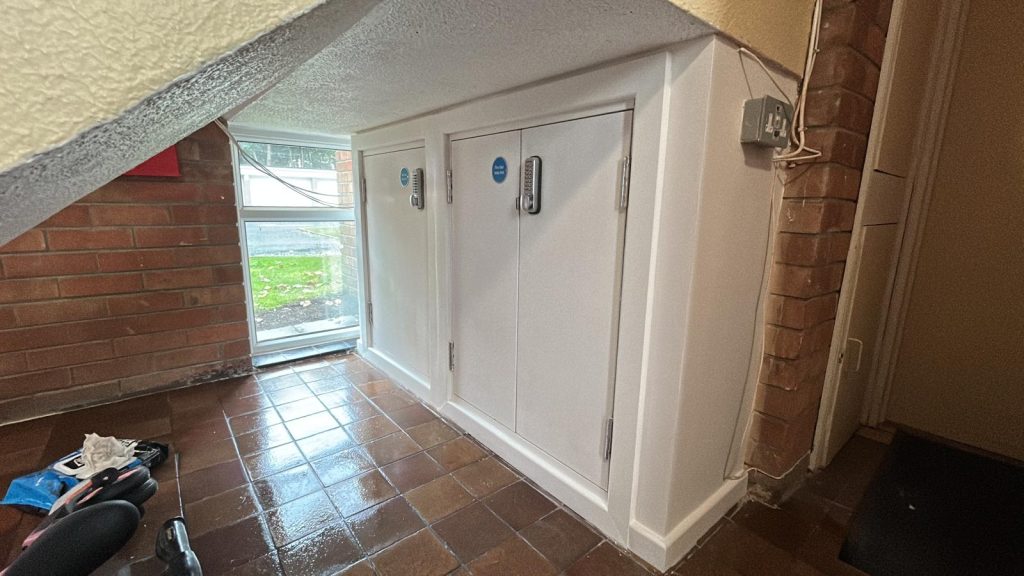
If you’re looking at a fire door and wondering whether it would actually pass an inspection, there are a few things you can check yourself.
Some problems are obvious. A door that doesn’t close properly or has visible damage needs attention. Other issues are harder to spot and may need someone who knows what they’re looking at.
Below, we’ve answered some of the most common questions we get about fire doors.
Should a fire door close by itself?
Where a fire door requires a self-closing device, yes.
Open the door and let it go. It should close fully into the frame without you having to pull or push it shut.
A useful check is to try it from fully open and then again from around 15 degrees. Government guidance says it should close fully in both cases, overcoming the latch and any resistance from the floor.
If it stops short, catches on the floor or needs a push to close properly, something needs looking at.
How big should the gaps around a fire door be?
The gaps matter because a fire door needs to restrict the passage of fire and smoke.
Government guidance says the gap between the door and frame should not be more than 4mm. The gap underneath is treated differently and should be as small as practicable while still allowing the door to operate correctly.
Don’t assume a door is fine just because it shuts. Uneven or excessive gaps can still be a problem.
Does a fire door need intumescent strips and smoke seals?
Modern fire doors will commonly have intumescent strips fitted into the door or frame. These expand when exposed to heat and help seal the gap around the door. Smoke seals may also be fitted to restrict the movement of smoke.
If they’re present, check that they’re intact and haven’t been damaged.
There is an important exception here. An older fire door isn’t automatically unsuitable because it doesn’t have modern seals. Government guidance recognises that some older fire doors were manufactured to earlier standards and may still provide adequate protection.
That’s one of the reasons it’s worth getting the door properly assessed rather than assuming an older door needs replacing.
Should there be a label on my fire door?
Newer certificated fire doors will often have a label or plug identifying the manufacturer and fire performance of the door.
It’s useful evidence when you’re trying to establish exactly what has been installed.
However, no label doesn’t automatically mean the door has failed. Current government guidance specifically states that a lack of certification does not, by itself, mean an existing flat entrance door is unfit for purpose.
If you can’t identify the door or you’re unsure about its fire performance, that’s where a proper assessment becomes important.
What should I check on the hinges?
Look at whether the hinges are secure and whether there are any loose or missing screws.
Also look at how the door is sitting in the frame. If it has dropped, the gaps around it may have changed or the door may no longer close correctly.
Don’t just tighten or replace components without knowing whether they’re suitable for that particular fire door. The hardware forms part of how the complete door performs.
Can a fire door have glass in it?
Yes. Fire doors can contain glazing, but that doesn’t mean any piece of glass can be fitted into one.
The glazing and the system holding it in place need to provide the required fire resistance. If the glass is damaged or appears to have been replaced, it should be checked. Government guidance specifically includes glazing as part of the visual checks carried out on fire doors.
Does a fire door need a door closer?
It depends on where the fire door is being used.
For example, government guidance requires effective self-closing devices on flat entrance fire doors and fire doors within common parts covered by the Fire Safety (England) Regulations 2022.
A closer isn’t doing its job simply because one is attached to the door. It needs to actually close the door fully.
If you’re unsure whether a particular door requires one, get the door assessed rather than adding or removing hardware yourself.
Can I wedge a fire door open?
Generally, a fire door that needs to remain closed shouldn’t simply be wedged open.
The door can only restrict fire and smoke when it’s in the position it was designed to be in.
There are situations where doors are held open using suitable systems that release the door when the fire alarm or smoke detection system activates. That’s very different from sticking a door wedge underneath it.
Does damage mean the whole fire door needs replacing?
Not necessarily.
Some defects can be dealt with through fire door remedial work. Whether that’s appropriate depends on what is wrong with the door and whether the repair can be carried out without compromising its fire performance.
If the door or frame is too badly damaged, replacement may be the correct option.
At D2, we assess the existing door first. If it can be appropriately remediated, we’ll tell you. If it needs replacing, we’ll explain why.
How often should fire doors be checked?
That depends on the building and the type of door.
For multi-occupied residential buildings in England over 11 metres, the Fire Safety (England) Regulations require responsible persons to check fire doors in communal areas at least every three months. They must also use best endeavours to check flat entrance doors at least every 12 months.
Those rules shouldn’t be applied blindly to every fire door in every property. Different premises have different requirements, and the building’s fire risk assessment also matters.
Can I check a fire door myself?
You can spot plenty of basic problems yourself.
Check whether the door closes properly. Look for damage, excessive gaps and obvious problems with the frame or hardware. Check the condition of seals where they’re fitted.
Government guidance actually expects many of these basic checks to be possible without specialist expertise. But it also makes clear that these checks aren’t a replacement for a more detailed assessment where one is required.
So if you’re responsible for the property and aren’t confident about a door, don’t guess.
What happens if my fire door isn’t compliant?
The answer isn’t automatically “you need a new fire door.”
It could need an adjustment or suitable remedial work. There may be a problem with one of the components. In other cases, replacing the door set may be the appropriate solution.
D2 provides fire door inspections, remedial works, maintenance and fire door installation across Liverpool, Merseyside and surrounding areas.
If you’ve already had an inspection and have a list of failed doors, we can work from the report. If you don’t know what condition your fire doors are in, we can assess them first and explain what actually needs doing.